
The Indian Higher Education Crisis Exposed: Salary Laundering, Ghost Faculty, and Research Paper Rackets

Updated: Jan 29
Higher education, we are told, has transformed. NEP 2020 is the headline. Change is the slogan. But on the ground, inside classrooms and staff rooms, nothing feels transformed.
Over the last six months, I spoke to more than 100 teachers and faculty members.
Across private colleges. Across private universities. Across states.
Every conversation was confidential. Every voice carried fear.

And every story pointed in the same direction. What they shared is not written in brochures.
It is not discussed in conferences. It never appears in accreditation reports.
It lives in staff rooms. In late-night calls. In resignation drafts never submitted.
Teachers spoke about salaries that vanish after audits. About colleagues who exist only on paper. About marks adjusted to please management. About research reduced to cheap labour.
None of them wanted publicity. All of them wanted relief.
This article is not opinion. It is documentation.
Built from patterns that repeat across institutions. What follows are the darkest realities of Indian higher education.
The kind teachers are warned never to say out loud.
This is only Part One. And it is long overdue.
Shock Point 3 - Teachers Turned Recruiters: Admission Targets and the Indian Higher Education Crisis
Shock 1 - Salary Laundering with Cash Returns: A Hidden Layer of the Indian Higher Education Crisis
On paper, everything looks legal. Appointment letters mention UGC pay scales. Salary slips show full amounts. Bank statements reflect compliance.
On the ground, money flows backwards. Across multiple states, faculty members described the same routine, using different words, but following identical steps.
This practice is commonly referred to inside campuses as
“salary adjustment”
or
“refund system”.
In reality, it is salary laundering.
What the Numbers Look Like
Most faculty reported being forced to return
40 to 60 percent of their monthly salary.
In some cases, assistant professors earning ₹50,000 on paper were left with ₹20,000 to ₹25,000 in hand.
Senior faculty reported returns touching ₹40,000 to ₹60,000 per month.
This is not anecdotal. High Courts in Kerala, Karnataka, and Telangana have recorded cases
where teachers were compelled to return salaries after bank credits.
State education departments have acknowledged receiving complaints.
UGC has admitted receiving representations. Very few cases reach final judgment. Fear stops most of them.
How the System Works Step by Step
Faculty across institutions described a nearly identical process.
Step 1: Clean Appointment Letter
Teachers are issued appointment letters showing UGC or AICTE compliant pay. This document is used for audits and inspections.
Step 2: Full Salary Credit
Salary is credited fully into the bank account. This creates a clean financial trail. NAAC and NBA inspections rely on this.
Step 3: Informal Instruction
Within days, teachers receive verbal instructions. Sometimes from HR. Sometimes from the HOD. Sometimes directly from management. The message is simple. Return the excess. No email. No written order.
Step 4: Cash or Digital Return
Teachers are asked to withdraw cash and return it physically. In recent years, UPI transfers to personal accounts are also used. Often to relatives of management. Never to official accounts.
Step 5: Silence Clause
Teachers are reminded that contracts are temporary. Renewals are discretionary. Complaints mean exit. Many are told bluntly.
“This is how everyone survives here.”
Why Universities Do This?
The incentives are structural. Accreditation demands faculty strength. Regulators demand pay compliance. Parents demand rankings. Students demand placements.
Actual revenue does not match this narrative. So, institutions create a paper-perfect system. The cost is quietly pushed onto teachers. This allows colleges to meet regulatory norms without paying regulatory costs. Salary laundering becomes a business model.
Why Teachers Do Not Report?
Most faculty members are not reckless. They calculate risk daily. Private colleges dominate employment. Blacklisting is informal but effective. Labour cases take years. Regulatory bodies move slowly. Many teachers have EMIs. Children in school. Age limits closing in. So they comply. And they stay silent.
No education reform can succeed when the educator is financially insecure.
You cannot expect academic integrity from a system that survives on financial coercion.
Salary laundering does not just steal money. It steals confidence. It steals voice.
It trains teachers to accept illegality as normal. And when illegality becomes routine, education stops being education.
This is not a rare exception.
It is a repeated pattern.
And it sets the tone for everything that follows.
Shock Point 2 - Ghost Faculty and Paper Professors: How the Indian Higher Education Crisis Is Built on Fiction
Every accreditation file looks impressive. Faculty strength is complete. Student–teacher ratios are perfect. Departments appear fully staffed.
Then classes begin.
And suddenly, half the faculty is missing.
This is where the idea of ghost faculty enters Indian higher education.
Over the last six months, faculty members across multiple states described the same practice.
What “Ghost Faculty” Actually Means
Ghost faculty are individuals listed as full-time teachers who do not teach there.
Some are retired. Some work in another institution. Some live in another state. Some have never worked there at all.
Yet, on paper, they exist.
Their names appear in NAAC submissions. NBA faculty lists. AISHE data. University inspection files.
Classrooms remain understaffed. Files remain flawless.
How the System Works Step by Step
Faculty described a predictable pattern.
Step 1: Borrowed Identities
Colleges collect Aadhaar, PAN, and certificates of retired professors or teachers willing to “help”.
Some are paid a small honorarium. Some are promised future Favors. Some do not even know their documents are being reused.
Step 2: Multiple Appointments
The same faculty member appears as full-time staff in two or three institutions simultaneously.
Inspection schedules rarely overlap. The risk stays low.
Step 3: Inspection Time Theatre
When NAAC or NBA teams visit, temporary faculty are hired. Timetables are adjusted.
One person handles multiple classes. Everything looks normal. For two days.
Step 4: Post-Inspection Disappearance
Once the team leaves, the borrowed faculty disappears. The workload falls back
on a few permanent teachers. Classes continue. Compliance ends.
Why Institutions Do This
Hiring qualified faculty is expensive. Retention is harder. Paying UGC scales reduces margins.
Ghost faculty solve three problems at once.
They satisfy regulators.
They reduce salary bills.
They inflate institutional image.
It is cheaper to fake presence than to build capacity.
The Impact on Real Teachers
Permanent faculty pay the price. They teach extra hours. They cover missing subjects. They handle labs without support. They absorb academic pressure. Workload norms collapse.
Research time disappears. Burnout becomes routine. Yet during audits, they are told to smile. And keep quiet.
The Impact on Students
Students believe departments are strong. In reality, courses are handled by overworked teachers. Specialisations exist only on paper. Mentorship vanishes.
Research guidance weakens. Academic depth thins out. Degrees survive. Education does not.
Why This Continues
Detection is difficult. Punishment is rare. Data is self-declared.
Regulatory systems depend on documents. Institutions learn to perfect documents. And silence keeps the system alive.
Ghost faculty do not just fool regulators. They distort the entire academic ecosystem. They reward dishonesty. They punish sincerity. They normalise deception. When teaching becomes performative, learning becomes optional. And when presence itself is fake, quality never had a chance.
Shock Point 3 - Teachers Turned Recruiters: Admission Targets and the Indian Higher Education Crisis
Teaching was never meant to be sales. Inside many private colleges, it quietly is.
During interviews, faculty members used different phrases.
“Admission responsibility.”
“Outreach duty.”
“Student mobilisation.”
“Awareness Campaign.”
“Campus Tour.”
The meaning was the same. Bring students. Or face consequences.
What Admission Targets Look Like
Faculty reported targets ranging from 10 to 30 students per year.
Engineering colleges.
Management institutes.
Private universities.
Targets vary by department.
By seniority.
By market pressure.
No target is written officially.
Everything is verbal. Everything is understood.
How the System Works Step by Step
Faculty narratives followed a familiar pattern.
Step 1: Normalisation
Teachers are told admission support is part of “institutional growth”.
It starts casually. Counselling calls. School visits. Parent meetings.
Step 2: Individual Targets
Soon, numbers appear. Quietly. Informally.
“Everyone should contribute.”
“Just help a little.”
“You are part of our family.”
“Lets work for the Mission of this Campus.”
No email. No circular. Only expectation.
Step 3: Performance Linking
Targets begin to affect everything.
Workload allocation.
Timetable preference.
Internal evaluations.
Contract renewals.
Academic performance fades.
Admissions matter.
In Simple terms:
If you are Good Sales person = Less Teaching Load.
Step 4: Pressure Tactics
Faculty who fail targets are called out in meetings.
Compared publicly.
Assigned extra classes.
Some are denied leave.
Some lose responsibilities.
Some lose jobs.
Why Institutions Push This
Private colleges survive on fees. Competition is brutal. Marketing is expensive.
Faculty become the cheapest channel. They already have credibility. They already have networks. They already have trust. Turning teachers into recruiters costs nothing.
The Impact on Teaching
Classrooms suffer first. Teachers spend weekends selling courses. Evenings following up leads.
Mornings filling enquiry sheets. Preparation time shrinks. Mentorship disappears.
Research pauses indefinitely. Teaching becomes secondary.
Admissions become survival.
The Impact on Faculty Dignity
This shift breaks something deeper. Teachers are evaluated not by knowledge, but by conversions.
A good academic with zero admissions is labelled “non-cooperative”.
A weak teacher with strong admissions is praised.
The message is clear. Pedagogy does not pay. Sales does.
Why This Is Rarely Spoken About
Targets are unofficial. Pressure is subtle. Proof is hard.
Complaints invite retaliation. Most faculty choose silence.
It feels temporary. Until it becomes permanent.
And if a faculty retaliates, she will be blacklisted.
Management of Universities are well connected with other Management.
When teachers are forced to sell seats, education becomes a product.
Not a public good. You cannot build thinkers in a system obsessed with numbers.
And when admissions define worth, academics lose meaning.
This practice does not just hurt teachers. It reshapes institutions.
Shock Point 4 - Mark Manipulation and Exam Fixing from Inside: Engineering Results in the Indian Higher Education Crisis
Most people think exam fraud happens outside.
Coaching centres.
Paper leaks.
Impersonation.
Inside colleges, it is quieter. Cleaner. More sophisticated.
Faculty across institutions described result manipulation as an internal process.
Routine. Normalised.
What Mark Manipulation Looks Like
It rarely looks dramatic. No sudden jumps. No obvious cheating. Just small changes. Across many answer sheets.
Two marks here. Five marks there. Enough to pass. Enough to improve averages. Enough to protect reputation.
How the System Works Step by Step
Faculty accounts followed a consistent structure.
Step 1: Internal Assessment Control
A large portion of marks comes from internal evaluation.
Assignments.
Attendance.
Mid-semester tests.
Faculty are told quietly to be “liberal”.
Everyone understands what that means.
Step 2: Pre-Exam Signals
Before final exams, informal instructions circulate.
“Pass percentage should not fall.”
“Department results look weak.”
“Management is watching.”
Nothing is written. Everything is implied. HODs allow it so that it does not effect his KPI.
Step 3: Evaluation Pressure
During paper valuation, faculty are asked to reconsider borderline cases.
“Recheck once more.”
“Student is good.”
“Don’t spoil future.”
Failing students becomes risky. Passing them becomes safe.
Step 4: Moderation Engineering
Moderation committees exist on paper.
In reality, marks are adjusted to meet targets.
Department-wise averages matter.
University rankings matter.
Marketing brochures matter.
Step 5: Silence After Results
Once results are published, discussion ends. No audit. No review. No accountability.
The numbers are celebrated. The process is forgotten.
Why Institutions Do This
Failure affects admissions.
Failure affects image.
Failure scares parents.
High pass percentages sell trust. Quality does not sell seats. Numbers do. Manipulation becomes risk management.
The Impact on Teachers
Faculty are placed in conflict. Evaluate honestly and invite trouble.
Adjust marks and keep peace. And safeguard jobs and increments as it is linked to KPI.
Over time, ethical fatigue sets in. Teachers stop questioning. They comply. They move on.
The Impact on Students
Students learn quickly. Effort is optional. Attendance is negotiable. Results are adjustable.
The value of learning collapses. Degrees multiply. Skills disappear.
Why This Rarely Surfaces
Everything happens internally. Records look legitimate. Instructions stay verbal. Whistleblowing means isolation. Most choose survival.
When marks are engineered, education loses its spine.
Exams stop measuring learning. They start protecting brands.
And when teachers are forced to dilute standards repeatedly, mediocrity becomes institutional culture.
This damage does not appear immediately. It shows up years later.
In workplaces.
In research labs.
In leadership.
Shock Point 5 - The Research Paper Laundering Racket: Where the Indian Higher Education Crisis Destroys Knowledge
This is where higher education quietly collapsed. Not in classrooms. Not in policies.
Inside research cabins.
Across private universities and colleges, research has been reduced to a transactional process.
Publicly, institutions speak of innovation.
Privately, they run publication factories.
What Research Paper Laundering Really Is
Research paper laundering means work done by one person is published under another’s name.
It is not rare.
It is organised.
Research scholars write. Junior faculty execute. Senior faculty claim authorship.
Sometimes willingly. Often under pressure.
How the System Works Step by Step
Faculty and scholars described a disturbingly consistent process.
Step 1: Publication Pressure
Institutions mandate publications. For confirmation. For promotion.
For accreditation points. Quantity matters more than quality.
Step 2: Delegation Without Credit
Senior faculty “assign” topics. Scholars do the work.
Data collection.
Literature review.
Analysis.
Drafting.
Authorship is discussed later. Usually denied.
Step 3: Paid Journals and Predatory Routes
Scholars are pushed toward predatory or low-quality journals.
Fees range from ₹5,000 to ₹50,000 per paper.
Institutions know these journals. They accept them anyway. Numbers matter.
Step 4: Forced Authorship Adjustments
Names are reordered. Supervisors appear first. Management nominees are added. Objections are discouraged. Silence is rewarded.
Step 5: Delay as Control
PhD completion stretches. Five years become seven. Seven become eight. More work extracted. More papers produced. Cheap labour retained.
The Life of a Research Scholar
Most scholars are not researching. They teach full courses. They manage labs. They handle admissions work. They do clerical tasks.
Stipends range from ₹15,000 to ₹30,000 in many private institutions.
Rent consumes most of it. Food becomes secondary.
Conferences are self-funded. Equipment is self-funded.
Even journal fees are self-funded. Survival replaces curiosity.
Why Institutions Encourage This
Publications feed rankings. Rankings feed admissions. Admissions feed revenue.
Research scholars are the cheapest resource.
They do not unionise.
They fear exit.
They fear blacklisting.
The system exploits that fear.
The Damage to Indian Research
Original thinking collapses. Plagiarism increases. Reputation suffers globally.
India produces papers. Not breakthroughs.
Metrics rise. Meaning falls.
Why This Rarely Gets Exposed
Authorship disputes are hard to prove. Guides hold power. Institutions close ranks.
Scholars stay silent to finish degrees.
Most leave academia. Burnt out. Disillusioned.
Research cannot survive in a culture of coercion.
When curiosity is replaced by targets, knowledge becomes paperwork.
This racket does not just harm scholars. It destroys the future of Indian higher education.
These 5 are deadly, real, and rarely known by the public.
Where This Ends If We Continue Like This: The Long-Term Cost of the Indian Higher Education Crisis
If we continue like this, degrees will multiply.
Competence will disappear.
Universities will look global.
Graduates will feel incomplete.
Teachers will leave classrooms.
Scholars will abandon research.
Education will become ceremony.
A country cannot build the future by exhausting the people who shape minds.
Reforms without teacher dignity are cosmetic. And short-lived.
A Message to the Ministry of Education
Policy alone does not teach.
Teachers do.
Five things demand attention.
Enforce pay compliance on the ground, not on paper.
Audit faculty presence physically, not through files.
Protect whistleblowers inside institutions.
Separate accreditation from self-declared data.
Measure teacher wellbeing as a reform indicator.
Revolution cannot be outsourced. It must be enforced.
A Message to University Managements
Institutions are built by trust.
Not spreadsheets.
Five realities to reflect on.
Faculty are assets, not cost centres.
Fear-driven systems kill long-term reputation.
Compliance theatre always collapses eventually.
Ethical institutions attract better students organically.
Short-term profit creates long-term decay.
Your brand is your people. Treat them accordingly.
A Message to Heads of Departments
Leadership is not control.
It is protection.
Five reminders.
Shield junior faculty from illegal pressure.
Do not trade ethics for convenience.
Respect workload limits honestly.
Credit research fairly.
Remember, silence also teaches culture.
Departments reflect their heads. Always.
A Message to Faculty and Research Scholars
You are not weak. You are overburdened.
You are not incompetent. You are unsupported.
Do not internalise systemic failure.
Do not normalise exploitation.
Document. Connect. Protect each other.
History changes slowly. But it starts with truth.
A Message to Parents and Students Seeking Admission
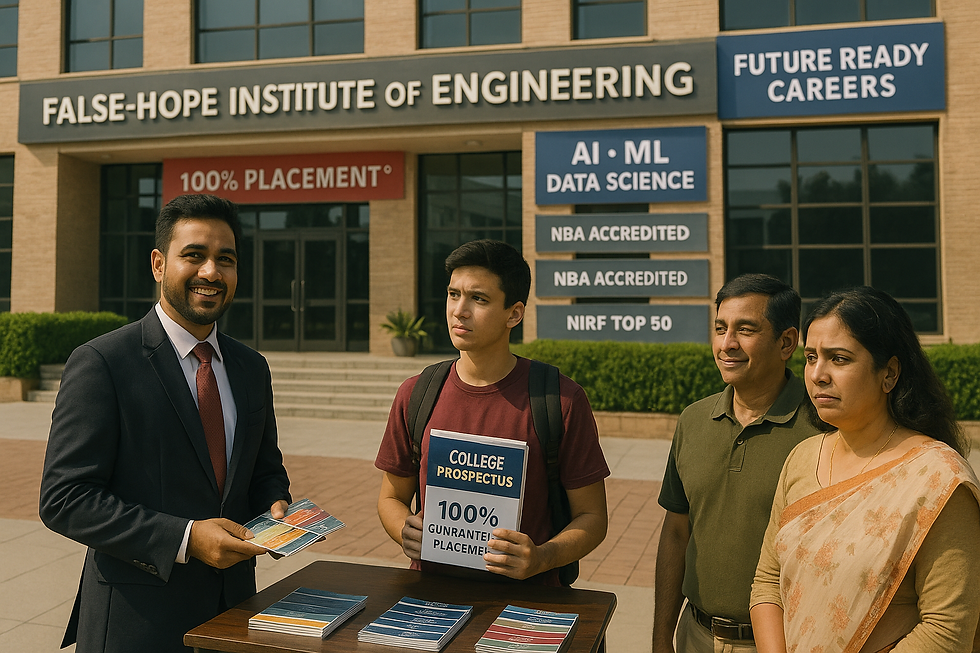
Rankings lie. Buildings impress.
Advertisements perform.
Education reveals itself quietly. Look deeper.
Ask about faculty stability. Ask about research ethics.
Ask about mentorship time. Ask where graduates actually land.
Over the last decade, I have worked closely with universities.
Good ones exist. Ethical ones exist.
They are just not the loudest.
The biggest damage caused by today’s higher education system is not unemployment.
It is misalignment.
Bright students pushed into the wrong streams.
Parents investing blindly.
Institutions chasing admissions, not outcomes.
Coming out of this dream world needs clarity.
Not motivation.
Not hype.
What to Expect in Part Two of This Investigation
This article only scratches the surface.
Part Two goes deeper.
Much deeper.
Here is what will be uncovered next.
How accreditation inspections are stage-managed like theatre.
How faculty silence is engineered through contracts and fear.
How whistleblowers are quietly isolated and pushed out.
How regulatory loopholes are known, mapped, and exploited.
How some “top-ranked” institutions survive on compliance fiction.
We will also examine, Who benefits from this crisis, why reforms stall after announcements, and how accountability keeps slipping through the cracks.
Some names will make people uncomfortable.
Some systems will feel exposed.
Some beliefs will not survive.
Part Two is not for casual reading.
It is for those who want to understand why the Indian Higher Education Crisis keeps repeating itself.
If this article disturbed you, Part Two will force you to choose a side.
Stay tuned.
The silence breaks next.
Thanks for diving into this article!
Hi I am Dr. DD, and as a Career Science Researcher, I work at the intersection of neuroscience, psychology, and career mapping.
Every student has a natural instinct. A cognitive pattern. A learning rhythm.
Career decisions should not be driven by hype. They should be driven by self-awareness.
If you want to talk to me 1-on-1 about how all this affects your life → Click Here
Need full career clarity? Test + Report + Counselling → Start Here
Want deeper insights into Outcome-Based Education?
My highly acclaimed book, now in its revised second edition, is used by 1,000+ institutes: Buy It Here
Curious about who I am? Get to know me better: Click here
Interested in exploring what I do? Check out my work: Click here
Love thought-provoking content? Subscribe to my website for regular inspiration: www.deepeshdivakaran.com/subscribe
Connect with me on Linkedin: Click Here



I've been using IXL for a while and started looking into what else is out there, mostly because my kid needed actual explanations rather than just practice loops. Turns out the landscape is pretty different depending on what you're after. For anyone doing the same research, this breakdownhttps://brighterly.com/blog/ixl-alternatives/covers the options in a way that's actually organized by what problem you're trying to solve, which I found more useful than generic comparison lists. Platforms like Brighterly or Wyzant are a different category entirely since they connect you with a real tutor who can answer questions in the moment, while things like Prodigy or Khan Academy stay closer to what IXL does but with a different format or price point. Miacademy and…
HAPPY NEW YEAR.
YES OUR SONS SUFFERED, TARGETED YES = PLEASE HELP. THANK YOU. BEST WISHES. AUMMM...
Although in severe shock and great stress, we have faced the challenges and moved forward crossing the barriers biases impediments etc that came before us, it was tough, not easy, for my wife and sons and the others also I brought up my two sons Kaviraj and Shilpi as future presidents of usa, with that attitude/ outlook/ mindset, supporting and encouraging the leadership nature already in them. They are born in usa, grew up in usa and consider themselves as Americans. The country, the people and the whole world including India where we parents are originally from will need their leadership and contributions to go forward towards better future vision in true spirit of America. It is the nature of truth, nature…