
Engineering Education Crisis: BTech and MTech Degrees Are Dead, But Admissions Are Still Open

Updated: Dec 9, 2025
A fact-based investigation into fake placements, AI / ML rebranding, and the slow collapse of employability in engineering colleges. And we are in between serious Engineering Education Crisis.
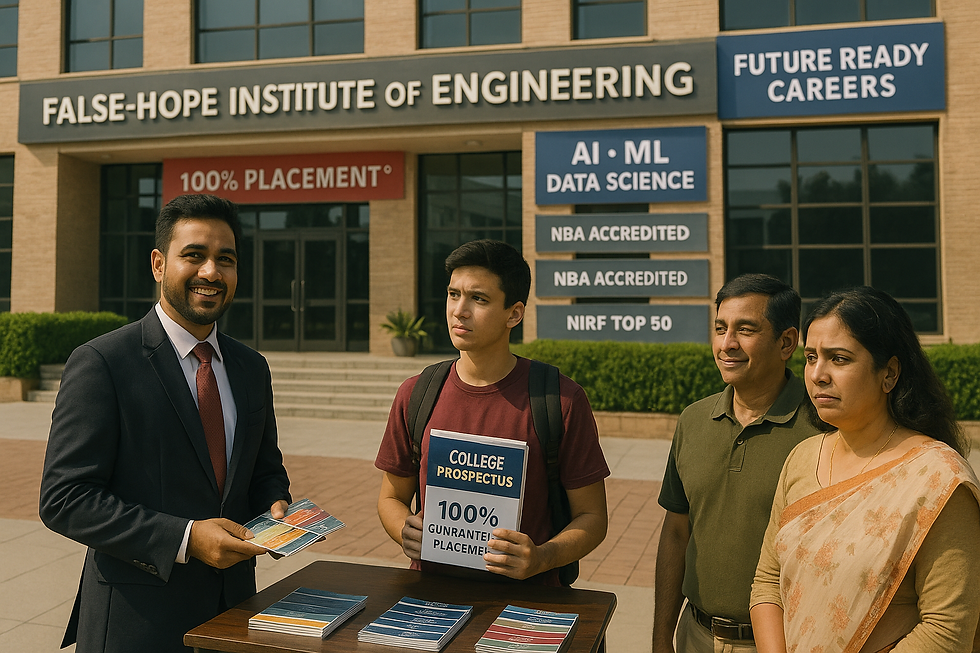
Many will not like what I am about to say.
Some will disagree publicly.
And agree privately.
Some will call it pessimism.
I will say it anyway.
Because parents deserve truth.
Not comfort.
If you are a parent worried about your child’s future,
and you believe engineering is the safest path,
you are already operating on an outdated assumption.
And this is not just India.
This is global.
Across the world, engineering education is losing relevance fast.
Not engineering itself.
But the way it is taught, sold, and scaled.
Colleges did not collapse because of Artificial Intelligence.
They collapsed because they failed to see the trap they created.
Over the last decade, AICTE, UGC, and institutions chased surface level modernization.
"AI."
"Machine Learning."
"Data Science."
"Blockchain."
All Buzzwords.
Regulators promoted them as future-ready.
Colleges rushed to adopt them.
But beneath the titles, nothing changed.
Most AI and ML programs were not revolutionary.
They were decade-old computing structures.
Rebranded.
Same syllabus depth.
Same faculty gaps.
Same exams.
Same disconnect from real jobs.
The label changed.
The substance did not.
An illusion was created.
Parents believed relevance was guaranteed.
Students believed jobs would follow.
Colleges believed branding was enough.
AI did not destroy engineering education.
It exposed how hollow it already was.
This is not a slowdown.
This is the beginning of the end of traditional engineering models.
The faster we accept this,
the faster we protect the next generation from irreversible mistakes.
1. Engineering Colleges Are No Longer Employability Institutions
India currently produces 15–16 lakh engineers every year
Industry absorbs less than 25% meaningfully.
Multiple independent studies show:
Only 45–47% engineers are even employable at entry level.
For IT roles, the number drops below 40%
For core engineering roles, often <15%
This means:
Half of engineering graduates are unplaceable at graduation.
Colleges still advertise placement records.
They show company logos.
They hide conversion ratios.
Visiting company ≠ hiring company.
This is credential inflation without outcome accountability.
2. AI Didn’t Kill Jobs: It Killed Average Engineers
AI is not hiring freshers.
AI is replacing fresher roles.
As per reading various reports I estimate:
Entry-level IT roles may shrink 65% by 2030.
AI increases productivity, not headcount.
One skilled engineer now does work of 6 - 9 juniors
Earlier model:
Learn basics → Train on job
Current model:
Arrive trained or don’t arrive at all
Colleges still promote:
AI
ML
Data Science
Reality:
Less than 5–7% students reach usable AI skill depth
Most “AI courses” are rebranded programming syllabi
This is not future-proofing.
This is keyword marketing.
3. Engineering ROI Has Collapsed, Quietly
Let’s look at numbers parents rarely calculate.
Cost:
Private engineering fees: ₹10–20 lakh
Living + opportunity cost: ₹4–6 lakh
Total investment: ₹14–26 lakh
Return:
Average campus salary: ₹4–6 LPA
Net take-home: ₹35–45k/month
Job stability: weak
Growth timeline: 3–5 years
Compare this to:
Specialized diplomas
Skill-first bootcamps
Entrepreneurship + apprenticeships
Engineering is no longer a low-risk bet.
It is a high-cost, delayed-break-even gamble.
Yet parents are sold safety.
That’s financial misinformation.
4. Private Universities and Colleges Survive on Storytelling, Not Outcomes
If placement transparency was enforced, many private colleges would shut down in 2 years.
Here’s how manipulation works:
Top 5% shown as “average”
International offers exaggerated
Internship converted into “placement”
Unplaced students disappear from records
Salary CTC inflated by bonuses and stock labels
There is:
No standardized placement audit
No public employability scorecard
No consequence for false narrative
Education has become aspirational advertising.
5. Engineering Admissions Exploit Fear, Not Fit
The system doesn’t ask:
Is the student cognitively aligned?
Does the student enjoy abstraction?
Can the student handle sustained problem-solving?
Instead, it sells:
Fear of missing out
Fear of judgment
Fear of non-engineering paths
Admission counselling is not counselling. It is sales.
And students discover the mismatch only after four years.
That is not ignorance.
That is negligence.
Engineering Education Crisis: What the Future of Education Actually Looks Like?
The degree is losing monopoly.
The future belongs to:
Skill stacks, not certificates
Measurable capability
Apprenticeship-driven learning
Neuro-aligned career paths
Lifelong re-skilling cycles
Universities that don’t adapt will:
Become irrelevant
Become credential warehouses
Be bypassed by industry-created alternatives
This transition will be brutal.
A Hard Criticism of Government & University Owners
Government Failure:
Excessive seat approvals
No employability regulation
No ROI accountability
No placement data audits
Policy lagging industry reality by 10 years
Private University Failure:
Marketing over mastery
Expansion without faculty depth
Degree inflation
AI washing old syllabus
Treating students as fee-units
This is not reform delay. This is systemic blindness.
Five Revolutionary Actions the Government Must Take
Freeze Engineering Seat Expansion indefinitely. Quality before quantity.
Make Placement Audits Mandatory. Public, third-party audited employability data.
Link Degree Approval to Industry Absorption Ratios
Fund Apprenticeship. First Education Models
Introduce ROI Disclosure Norms for Courses
Radical?
Yes.
Necessary?
Absolutely.
Five Actions Universities Must Take, Or Perish
Cut Admissions Intentionally. Fewer students. Higher outcomes.
Kill Generic AI Courses. Build depth or don’t teach it.
Measure Student Readiness, Not Attendance
Shift from Semester Model to Skill Milestones
Align Degrees with Neurological & Psychological Fit
Higher education is not dead.
Dishonest education is.
Most Engineering colleges will be closed in next 3 - 5 years.
Only truth-driven institutions will survive next Disruptions.
The rest?
History will archive them quietly.
If this article unsettles you, good.
Discomfort today prevents disaster tomorrow.
Waking Up From the Degree Dream
The biggest damage caused by today’s higher education system is not unemployment.
It is misalignment.
Bright students pushed into the wrong streams.
Parents investing blindly.
Institutions chasing admissions, not outcomes.
Coming out of this dream world needs clarity.
Not motivation.
Not hype.
Over the last few years, one truth became undeniable.
Career confusion is not an interest problem.
It is a data problem.
That is where our work begins.
By removing assumptions.
And replacing them with scientific clarity.
We use a combination of:
Neuroscience.
Psychology.
Fingerprint-based brain mapping.
Genome-linked aptitude indicators.
This helps us understand how a child’s brain is wired.
How they learn.
How they decide.
How they adapt.
How they perform.
This is not guesswork.
This is pattern science.
Our Research shows that, this methods help understand:
Who the student truly is.
What skills they must build.
Which careers will actually exist.
And how to reach them step by step.
This is backed by deep research.
We have mapped 7,000+ modern and emerging job roles, globally.
More details are available at:
For a direct, one-on-one conversation with me, you can book a personal appointment here:

Thanks for diving into this article!
If it sparked something within you, let's keep this momentum going.
Curious about who I am? Get to know me better: Click here
Interested in exploring what I do? Check out my work: Click here
Love thought-provoking content? Subscribe to my website for regular inspiration: www.deepeshdivakaran.com/subscribe
Want deeper insights into Outcome-Based Education? My highly acclaimed book is now used by 1000+ institutes—grab your copy at a special author price: Buy It Here at Special Author Price
Need detailed guidance on education policies? Download my free NEP 2020 Guides Download Now
Connect with me on Linkedin: Click Here
Have questions or want to chat directly? Reach me on call or WhatsApp at +91 8086015111.
Prefer emails? I love them too! Drop a line at mail@deepeshdivakaran.com.
Your thoughts matter. Let’s shape education's future together.
Stay Inspired. Stay Informed.


The statement “Engineering Education Crisis: BTech and MTech Degrees Are Dead, But Admissions Are Still Open” reflects a harsh but growing reality in today’s education landscape. Traditional engineering degrees are struggling to keep pace with industry needs, leading to rising unemployability despite increasing admissions. Many students invest years and money, only to realize that degrees alone no longer guarantee skills, jobs, or global opportunities.
As a result, learners are now exploring alternative pathways that offer practical exposure and international mobility. One such option is preparing for overseas education or careers through online IELTS training, which opens doors to universities, skill-based programs, and job markets abroad. Unlike stagnant degree models, global education focuses on adaptability, communication, and real-world competence. The crisis in…
The ongoing debate about the relevance of traditional BTech and MTech degrees reflects growing concerns over curriculum gaps, industry alignment, and rapidly evolving technology demands. Critics argue that conventional engineering programs may not fully equip students with practical skills, creativity, or interdisciplinary experience needed for today’s job market. However, admissions remain open as many institutions adapt by updating coursework, offering specialization tracks, and emphasizing experiential learning. For Indian students seeking broader or alternative global pathways, connecting with study abroad consultants in India can help explore diverse international programs, assess fit, and plan strategic study abroad options that align with future career goals.
This is a powerful and much-needed reality check on the engineering education system. The focus on buzzwords over real employability has clearly created confusion for students and parents alike. We see similar concerns among students planning to study abroad, where informed decisions about courses, universities, and career outcomes matter more than ever. At GraddingHomes, along with guidance on course and university selection, we also support students with student accommodation in Exeter, helping them settle better and focus on building real, job-ready skills. Thought-provoking read—thanks for sharing these insights.
With so much noise around degrees, rankings, and job promises, many students are starting to pause and ask a simple question: what actually prepares me for the real world? That’s where studying abroad often feels like a fresh start. Learning in countries like Australia isn’t just about lectures and exams—it’s about exposure, independence, and building skills that employers actually value. Of course, life outside the classroom matters too. Finding the right student accommodation in Sydney helps students settle in faster, feel at home, and focus on what truly matters—growing personally, professionally, and confidently in a new country.
Dr. Deepessh Divaakaran’s article is uncomfortable — and that’s why it’s important.
I agree with the core message: engineering education isn’t failing because of AI, but because degrees are being mass-produced without employability accountability. Buzzwords replaced skills, and placements replaced outcomes.
However, this does not mean engineering as a profession is dead. It means students must look beyond traditional, overcrowded local models and think globally.
Where Study Abroad Makes Sense
When chosen strategically, study abroad directly addresses many of these gaps:
Outcome-driven curricula with real industry projects
Smaller class sizes and updated syllabi
Shorter programs (1-year master’s in the UK) leading to faster ROI
Stronger alignment with global job markets
This matches the shift from certificates to measurable capability highlighted in the article.
Don’t Ignore Student…