
The HECI Bill Shock: Not a Reform. A Takeover. The Inside Story That Will Decide Who Survives in Indian Higher Education.

In a move that marks one of the most significant policy shifts in Indian higher education in decades, the Viksit Bharat Shiksha Adhikshan Bill (VBSAB), the legislation designed to establish the Higher Education Commission of India (HECI), has already been introduced in the Lok Sabha. Shortly after introduction, it was referred to the Joint Parliamentary Committee (JPC) for detailed examination.

The expectation among policy watchers is that the JPC report will be tabled in the upcoming Budget Session of Parliament, and that the Bill could be passed soon thereafter, possibly in the same session.
This is not a speculative timeline.
It reflects the urgency with which the government has been pushing the reform, the political capital invested in it, and repeated public statements by policymakers about making this a priority legislative agenda.
If the Bill is passed in the next session, implementation is unlikely to be instantaneous.
Based on comparable systemic reforms in Indian education policy and the complexity of integrating multiple regulatory functions, a phased implementation over 12–24 months is the most plausible scenario.
States, universities, and colleges will need time to align statutory frameworks, reconfigure governance mechanisms, and build digital infrastructure.
The new councils and digital platforms required under the Bill, from the National Higher Education Regulatory Council (NHERC) to the National Accreditation Council (NAC) and Higher Education Grants Council (HEGC), will demand both legislative notification and significant administrative capacity before they become fully operational.
India’s higher education system today is vast: more than 1,100 universities, nearly 45,000 colleges, and tens of millions of students.
It is a system that grew rapidly in scale over the last three decades, but one whose quality, accountability, and outcome visibility have repeatedly been questioned by employers, students, and international ranking systems.
The VBSAB is the government’s attempt to address these long-standing structural challenges. But it is important to understand that this is not merely about new bodies or renamed regulators.
This is about redesigning how the entire system thinks about quality, governance, measurement, and outcomes, from the syllabus a student studies, to the way institutions are funded, to the very meaning of accreditation in an increasingly data-driven world.
This article is not an endorsement of the Bill.
Nor is it a critique born of ideology.
It is a close, analytical look at what is changing, why it matters, how deep the implications go, and how swiftly actors across the system will be forced to adapt, whether they are ready or not.
It is to ask a harder question:
If implemented as envisioned, how will this law actually transform Indian higher education, in classrooms, syllabi, campuses, careers, and culture?
1. The Old System: What We Had, What It Did Well, and Why It Still Failed
For decades, Indian higher education was governed by a fragmented regulatory order:
UGC for universities
AICTE for technical education
NCTE for teacher education
PCI and others for professions
What this system did well
Let’s be fair.
It:
Prevented uncontrolled mushrooming of institutions
Created minimum infrastructure norms
Protected public interest in early expansion years
Built a national identity for higher education
Without UGC and AICTE, India may not have scaled at all.
Where it failed structurally
1. File-based governance
Quality became something you describe, not something you demonstrate.
Policies mattered more than processes.
SSR writing became an industry.
2. Visit-driven audits
Institutions prepared for inspectors, not for students.
Quality was seasonal.
3. Grade fetishism
NAAC grades became branding tools.
Parents saw “A++” and assumed excellence.
There was no visibility into:
Teaching quality
Assessment integrity
Graduate outcomes
4. Chairman-centric power
Multiple regulators meant multiple power centres.
Interpretation of rules depended on personalities.
Discretion became systemic.
5. Discipline silos
Engineering, arts, education, pharmacy lived in regulatory islands.
Interdisciplinarity was structurally discouraged.
So while the system scaled access, it failed to scale trust and outcomes.
2. What Is Being Dismantled, and What Is Not
Under HECI: UGC, AICTE, NCTE, PCI dissolve as regulators.
But two domains remain outside:
Medicine, under NMC
Law, under BCI
This already tells us something.
Despite the rhetoric of “one nation, one regulator”,
India is not yet ready to unify all knowledge systems.
Professions tied to public safety and licensure remain guarded.
So HECI is not total unification.
It is selective consolidation.
3. The New Architecture of HECI Bill: From Fragmentation to Functional Separation
What HECI is really attempting is not a merger of regulators, but a re-engineering of governance itself.
The old system was built on discipline silos.
Engineering here.
Arts there.
Education elsewhere.
Each with its own rules, audits, and power centres.
The new system is built on functions.
Who regulates.
Who accredits.
Who funds.
Who defines academic standards.
Instead of asking, “Which discipline are you?”
The system will ask, “Which function applies to you?”
At the heart of this design is the Higher Education Commission of India (HECI), operating under the Viksit Bharat Shiksha Adhikshan Bill (VBSAB), with four functional verticals:
1. NHERC - National Higher Education Regulatory Council: The regulator
2. NAC - National Accreditation Council: The quality judge
3. HEGC - Higher Education Grants Council: The money handler
4. GEC - General Education Council: The academic brain
Key principle: Regulation ≠ Accreditation ≠ Funding ≠ Curriculum
This separation is the soul of NEP 2020.
This mirrors governance logic seen in the UK, Australia, and parts of Europe, where quality, funding, and regulation are institutionally separated to avoid concentration of power.
But in India, this architecture carries an additional ambition: to unify the intellectual and administrative direction of higher education at a national scale.
3.1 The Big Picture: How the New Governance Stack Will Look
Here is how the full hierarchy of Indian higher education governance is likely to operate once HECI becomes functional:
3.1.1 Role of the Ministry of Education: The Political Nerve Centre
The Ministry of Education (MoE) will continue to:
Frame national higher education policy
Propose budgets to Parliament
Issue overarching directions
Represent India globally
Oversee HECI as the parent ministry
But MoE will no longer micromanage approvals or audits.
That operational burden shifts to HECI and its councils.
This is a classic move in modern states:
Keep policy and money with the ministry.
Shift execution and monitoring to statutory bodies.
If done right, this reduces political interference in daily regulation.
If done wrong, it creates two power centres with blurred accountability.
3.1.2 The President and Governors: The Constitutional Anchors
In India’s university tradition:
The President of India is the Visitor to Central Universities.
The Governor of each State is the Chancellor of State Universities.
(They are constitutional heads who appoint VCs and oversee governance.)
Under HECI, their role becomes even more crucial:
VC appointments will now happen in a system where regulatory compliance, accreditation maturity, and funding eligibility are tightly linked.
Governors, as Chancellors, will be under pressure to: Appoint leaders who can operate in a data-driven, outcome-based regime. Align universities with national academic frameworks set by GEC
This quietly means:
Political and constitutional leadership becomes a gatekeeper of academic culture.
VCs will no longer survive on legacy reputation.
They will be judged on:
System building
Outcome delivery
Compliance maturity
And yes, Politics.
This could professionalise leadership.
Or politicise it further.
The risk is real.
3.1.3 HERC: The Gatekeeper of Institutional Existence
The National Higher Education Regulatory Council will control:
Authorisation to start institutions
Approval for new campuses and programmes
Compliance monitoring
Revocation and closure powers
In essence, NHERC decides who gets to exist.
Deeper implications:
Entry barriers will become more data-driven.
Weak institutions may face closure or forced consolidation.
Expansion will depend on performance, not influence.
This will likely lead to:
Fewer but stronger institutions over time
Death of “license raj” colleges
Higher risk for marginal private players
NHERC is where the survival pressure will sit.
3.1.4 NAC: The Arbiter of Credibility and Trust
The National Accreditation Council becomes the single source of:
Institutional credibility
Programme-level quality validation
Public maturity grading
By absorbing NAAC and NBA, NAC becomes the trust engine of the system.
Its deeper role is not just grading.
It is to answer one national question:
“Which institutions can India trust with its youth?”
If NAC is strong:
Parents will finally see through marketing.
Students will choose based on maturity, not slogans.
Funding and autonomy will follow credibility.
If NAC fails:
We repeat NAAC in digital form.
Only the dashboards change. The games don’t.
NAC will decide whether HECI becomes reform or farce.
3.1.5 HEGC: The Translator of Quality into Money
The Higher Education Grants Council is where ideals meet reality.
It will define:
Who gets how much funding
On what basis
Linked to which outcomes and maturity levels
This introduces a new logic:
Money will no longer follow history. It will follow performance.
Deeper shifts:
Research output may outweigh enrolment size.
Governance integrity may outweigh political clout.
Outcome metrics may outweigh infrastructure show.
This is where the culture of entitlement must die.
But also where:
Metric manipulation
Data gaming
Cosmetic compliance can flourish if safeguards are weak.
3.1.6 GEC: The Quiet Shaper of Minds
The General Education Council may look technical, but it is the most ideological body.
It will define:
Learning outcomes
Qualification frameworks
Credit systems like ABC
Broad curricular expectations
This is where:
The idea of what an “Indian graduate” should be gets encoded.
Over time, GEC will influence:
How syllabi are designed
What competencies matter
How interdisciplinarity works
How Indian Knowledge Systems are integrated, if at all
Here lies a critical tension:
NEP speaks of:
Indian traditions
Bharatiya knowledge
Civilizational ethos
But the governance architecture still mirrors Western outcome frameworks.
So the question is open:
Will GEC merely adapt global templates?
Or will it truly encode a distinct Indian intellectual identity?
This will shape generations.
3.1.7 From Universities as Islands to a National Knowledge Grid
Put together, this architecture aims to convert Indian higher education from:
A loose federation of institutions
to
A nationally coordinated knowledge system.
Where:
Standards are common
Credits are portable
Outcomes are comparable
Data is unified
And ideology subtly aligns with national priorities
This is how the State seeks to:
Unify India’s intellectual and knowledge capacity.
Not by controlling content directly. But by shaping:
Frameworks
Outcomes
Incentives
Leadership
Universities will still teach.
But the direction of thought will increasingly be nationally framed.
This is powerful.
And it raises uncomfortable questions about autonomy.
3.1.8 A Shift from Indian Pluralism to Global Governance Logic
Philosophically, this architecture resembles:
UK’s OfS + QAA + funding councils
Australia’s TEQSA + grants system
European QA agencies
It is not rooted in India’s traditional models of:
Gurukula autonomy
Knowledge pluralism
Teacher-centric systems
Instead, it reflects:
A modern bureaucratic state managing knowledge at scale.
That is not wrong.
But it is a choice.
And it tells us that despite civilizational rhetoric, India is still building its higher education future on global administrative DNA, not indigenous epistemology.
4. From the Old Order to the New: What Is Really Changing
Every reform claims to be transformative.
Very few actually change the logic of how a system works.
What HECI attempts is not just replacing regulators.
It attempts to replace the operating philosophy of Indian higher education.
To understand this, we must stop looking at bodies and start looking at how power, quality, and trust are produced in the system.
The shift can be best understood by placing the old and new side by side.
4.1 Old System vs New System: A Structural Comparison
Dimension | Old System (UGC, AICTE, NAAC, NBA, etc.) | New System (HECI under VBSAB) |
Regulatory Logic | Discipline-based silos (technical, general, teacher education) | Function-based separation (regulation, accreditation, funding, standards) |
Power Centres | Multiple chairmen, parallel authorities | One apex commission with four verticals |
Approvals | Manual, file-heavy, visit-dependent | Online authorisation, data-driven, rule-based |
Compliance Culture | Prepare for audits | Live in continuous visibility |
Accreditation Philosophy | Grades (A, A+, A++) as symbols | Binary + Maturity-based levels as system health |
Outcome Focus | Weak, indirect, often narrative | Central, evidence-based, continuously tracked |
Programme Accreditation | NBA-led, discipline silos | Discipline verticals under NAC, integrated with institutional maturity |
Funding Logic | Entitlement and history-driven | Performance and maturity-linked via HEGC |
Transparency | SSRs and reports, limited public insight | Public dashboards, data disclosures expected |
Discretion | High human interpretation | Intended algorithmic and rule-based |
Institutional Autonomy | Negotiated, uneven | Expected to be maturity-linked and structured |
Student Visibility | Grades and rankings as proxies | Maturity levels + outcome signals |
System Identity | Regulator-centric | Platform-like governance system |
4.2 What Is Gained, What Is Lost
This shift is not neutral.
Potential Gains
Reduced overlap and confusion
Clear accountability by function
Better outcome visibility
Stronger link between quality and funding
Less room for narrative compliance
Potential Losses
Reduced flexibility for local contexts
Risk of over-centralisation
One-size-fits-all maturity metrics
Algorithmic rigidity replacing human judgment
Smaller institutions getting squeezed out
The old system was messy but negotiable.
The new system may be clean but unforgiving.
4.3 India in the Global Context: How Does the New System Compare?
To understand what India is becoming, we must see it against mature higher education systems.
Below is a simplified comparison with the USA and the UK.
Dimension | India (HECI Model) | USA | UK |
Governance Style | Strong central statutory regulator with functional separation | Highly decentralised, accreditation-driven, market-oriented | Central regulator with strong quality assurance |
Regulator | HECI with NHERC, NAC, HEGC, GEC | No single federal regulator; regional accreditors | Office for Students (OfS) |
Accreditation | National, maturity-based + discipline verticals | Peer-based, independent accreditors | QAA under national frameworks |
Funding Control | Central, performance-linked via HEGC | Mix of federal, state, endowments, tuition | Central funding councils with performance metrics |
Institutional Autonomy | Formally high, structurally bounded by maturity levels | Very high, market-disciplined | Moderate, regulated autonomy |
Outcome Focus | Strongly policy-driven, system-enforced | Employer and market-driven | Regulator and framework-driven |
Data & Transparency | Moving toward public dashboards and algorithmic oversight | Data exists but not centrally enforced | Strong national data systems |
Role of the State | Dominant architect and enforcer | Limited, facilitator role | Strong regulator and funder |
Knowledge Philosophy | Outcome frameworks + national priorities | Liberal education + market demand | Standardised frameworks + employability |
Risk Profile | High transition risk, large scale | Market inequality, cost explosion | Regulatory rigidity |
4.4 Three Critical Insights from the Comparison
1. India is choosing regulation over markets
Unlike the US, where competition disciplines quality,
India is betting on state-designed frameworks.
This can bring order.
But it can also bring bureaucracy.
2. India is closer to the UK than the US
The functional separation and strong regulator mirrors the UK model.
But India’s scale is far larger, and state capacity is uneven.
What works in the UK may strain in India.
3. India wants outcomes without full autonomy
Top systems globally pair outcome accountability with deep autonomy.
India wants outcomes, but within tight national frameworks.
This tension will define future conflicts.
4.5 Is India Building a Global System or an Indian One?
On paper, HECI reflects global governance logic:
Outcome frameworks
Functional separation
Central QA
Performance-linked funding
What is less visible is:
How Indian knowledge traditions shape curricula
How plural epistemologies survive standardisation
How diversity of thought coexists with uniform metrics
So far, the architecture suggests:
India is aligning with global administrative standards, not civilizational academic models.
That may help rankings.
It may help comparability.
But it raises a deeper question:
Are we reforming governance, or redefining what knowledge itself should look like in India?
That answer is still missing.
4.6 Why This Comparison Matters
Because systems do not fail only due to bad design.
They fail when:
Borrowed models ignore local realities
Metrics replace meaning
Control replaces trust
And scale overwhelms capacity
India is attempting what few nations have: to centrally redesign higher education at continental scale.
This is ambitious.
And extremely fragile.
5. Why This Reform Lives or Dies on Technology
If there is one truth that must be stated without hesitation, it is this:
HECI will fail if it becomes another paperwork-driven system.
It can succeed only if it becomes a technology-first, data-native governance platform.
Everything in the new architecture, regulation, accreditation, funding, standards, assumes one thing:
Continuous, reliable, comparable institutional data.
Not annual reports.
Not inspection-time uploads.
But live academic and governance telemetry.
5.1 From Episodic Audits to Continuous Visibility
The old system worked like this:
Institutions collected data once in 4–5 years
Wrote narratives around it
Uploaded SSRs
Faced visits
Then went silent again
Quality was episodic.
The new system demands:
Year-round data feeds
Outcome tracking every semester
Faculty, course, credit, assessment, progression data in real time
Research and governance indicators continuously updated
This is a shift from:
Audit culture
to
Visibility culture.
It changes how institutions think about themselves.
5.2 The Reality: India Already Has Many Platforms
India has not started from zero.
Over the last decade, massive investments have gone into national education platforms.
Some key ones:
ABC (Academic Bank of Credits)
National credit storage and portability system.
National Credit Framework (NCrF)
Defines how credits map to learning hours, skill levels, and qualifications.
DigiLocker / NAD (National Academic Depository)
Secure storage of academic credentials.
AISHE
Annual institutional statistics.
NIRF platforms
Ranking data systems.
UGC, AICTE, PCI portals
Each with its own approval, compliance, and data logic.
SWAYAM, SWAYAM PRABHA
National content delivery platforms.
Samarth ERP initiative
A government-backed ERP framework for universities.
The problem is not absence of systems.
The problem is fragmentation.
Each platform:
Speaks a different data language
Serves a different authority
Requires separate reporting
Has separate login, logic, and compliance cycles
Institutions are drowning in portals, not data.
5.3 HECI’s Unspoken Challenge: Integration at Scale
Under HECI, all of this has to converge.
NHERC will need: Institutional compliance and capacity data.
NAC will need: Teaching, assessment, outcomes, research, governance data.
HEGC will need: Performance metrics linked to funding.
GEC will need: Curriculum, credit, outcome mappings.
And all of it must align with:
ABC
NCrF
DigiLocker
NIRF
AISHE
This implies:
A national higher education data backbone that unifies:
Students
Faculty
Courses
Credits
Assessments
Outcomes
Institutions
Employers
Researchers
India is attempting to build a single academic truth layer across millions of learners.
Technically, this is a massive challenge.
Governance-wise, it is even bigger.
5.4 What This Means for Universities
Universities will no longer be allowed to:
Maintain parallel internal records
Patch data only during audits
Reconcile numbers later
They will be forced to:
Align internal systems with national schemas
Report continuously
Fix data at source
Treat data integrity as academic integrity
In effect:
Data becomes part of governance, not administration.
This will require:
Dedicated data governance teams
Academic process redesign
Faculty involvement in outcome capture
Leadership ownership of data truth
Most universities are not ready for this.
5.5 The Coming Disruption of the ERP Market
For two decades, Indian universities invested heavily in ERPs.
Most of them:
Promised integration
Delivered partial modules
Failed to adapt to regulatory complexity
Became expensive record-keeping tools
The result:
Fragmented deployments
Low faculty adoption
Heavy manual work despite ERPs
Under HECI, this model breaks.
Why?
Because:
Core data standards will be defined centrally.
Reporting will be dictated by national systems.
Universities will have less freedom to design their own schemas.
Over time:
ERPs will shift from being systems of record to being thin operational layers that feed national platforms.
Many ERP vendors will struggle.
Some will pivot.
Some will disappear.
The value will move from:
Customisation
to
Interoperability.
5.6 AI and Automation: Not Optional, But Inevitable
If NAC, NHERC, and HEGC rely on human scrutiny of millions of data points, the system will collapse.
The only scalable option is:
AI-driven anomaly detection
Automated pattern recognition
Flagging of inconsistent outcomes
Risk scoring of institutions
Predictive identification of failure trends
In simple terms:
AI will become the invisible inspector.
This can:
Reduce human discretion
Detect gaming early
Bring objectivity
But it also raises risks:
Opaque algorithms
Biased models
Over-reliance on metrics
India has little experience running AI-governed public systems at this scale.
The learning curve will be steep.
5.7 From Paper Classrooms to Tech-Enabled Learning Spaces
Once data becomes central, classrooms will not remain untouched.
Expect:
LMS becoming mandatory, not optional
Digital capture of attendance, assessments, outcomes
Blended learning as default
Micro-credentials embedded into programmes
Evidence trails for learning activities
The classroom will shift from:
A closed space of interaction
to
A digitally visible learning environment.
This changes pedagogy.
Faculty will need to:
Design measurable learning activities
Align assessments with outcomes
Use digital tools fluently
The romance of chalk and talk will not survive this regime.
5.8 The Cultural Shift: From Trust to Traceability
Perhaps the deepest change is cultural.
The old system ran on:
Personal trust
Institutional reputation
Historical legacy
The new system will run on:
Data trails
Dashboards
Cross-verification
We are moving from:
“Trust me, we are good."
to
“Show me your continuous evidence.”
This is not just technological.
It is philosophical.
It assumes: Institutions cannot be trusted without systems.
That is a heavy assumption.
But it defines the future.
And Necessary Devil to have.
5.9 The Risk: Digitising Dysfunction
There is a final danger.
If:
Data standards are weak
Integration is poor
AI models are naive
Portals are unstable
Then India will not get reform.
It will get:
A digital version of the same old dysfunction.
More portals.
More uploads.
More confusion.
Only messier.
6. What This Means for Parents and Students in a World That Is Resetting Itself
For most parents and students, policy language is distant.
What matters is simple:
Will my child get a better education?
Will this degree mean anything?
Will this system prepare them for the world they will live in?
To answer that, we must zoom out.
Because higher education today is not just being reformed.
It is being disrupted by a global reset.
AI is becoming indivisible from work.
Automation is rewriting professions.
Remote work is globalising competition.
And traditional degrees are steadily losing their monopoly on opportunity.
Across the world, we are seeing a clear pattern:
The value of degrees is slowly declining.
The value of demonstrable skills is sharply rising.
If we were to draw this as a trend:
The degree curve slopes downward over decades.
The skill curve rises steeply, especially after 2020.
They cross somewhere in the present generation.
This is not ideology.
It is visible in hiring data, freelance markets, and AI-driven job disruption.
And this trend is expected to continue for the next 30–50 years.
6.1 Where HECI Fits Into This Reset
Here is the uncomfortable truth:
HECI does not imagine a post-degree world.
It still imagines a world where universities remain the central engines of careers.
What it tries to fix is:
Governance
Accountability
Quality signalling
Funding logic
Not the fundamental question:
Should the degree still be the primary currency of opportunity?
So what HECI will likely do is:
Make degrees more standardised.
Make institutions more visible.
Make outcomes more trackable.
But it does not radically rethink:
How fast skills must change.
How informal learning will dominate.
How AI will flatten credential hierarchies.
This gap will define the next decade.
6.2 How Parents Will Start Looking at Institutions Differently
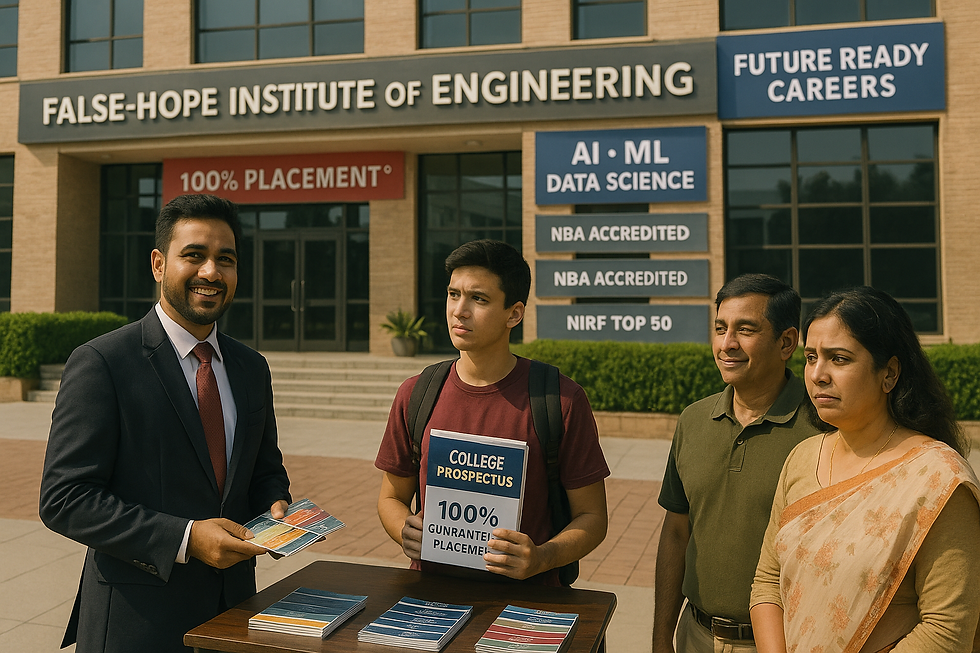
Today, many parents choose colleges based on:
NAAC grade
NIRF rank
Brand and legacy
Placement brochures
Under the new system, if it works as intended, parents will see:
Binary accreditation: Is this institution even fit to exist?
Maturity levels: How evolved are its systems?
Public dashboards: What are its outcomes really showing?
This will slowly shift parent mindset from:
“Is this college famous?”
to
“Is this college mature in how it teaches, assesses, and supports students?”
That is a healthy shift.
But it also means:
Marketing will become harder.
Transparency will become unavoidable.
Institutions hiding behind slogans will be exposed.
For parents, this could finally mean clearer signals.
For institutions, it means nowhere to hide.
6.3 How Students Will Experience Education Differently
Students entering colleges around 2026-2028 will be the first generation to feel the full force of this transition.
They will likely experience:
More outcome-linked curricula
More modular, credit-based pathways
More blended and tech-enabled classrooms
More continuous assessments
More visibility of their own learning data
The system will expect them to:
Prove learning, not just complete semesters.
Build portfolios, not just transcripts.
Navigate credits across institutions.
In short:
Students will be treated less as batch members and more as individual learning trajectories.
This is empowering.
But it is also demanding.
Students who are self-directed will thrive.
Those who depend on spoon-feeding may struggle.
6.4 The Disruption Parents Must Prepare For
For parents, the biggest shock will be this:
A degree will no longer guarantee clarity.
Even from a “mature” institution, a degree may not mean:
A stable job
A predictable career path
A linear growth trajectory
Parents will need to shift from asking:
“Which degree is safe?”
to
“Which learning environment builds adaptability?”
That is a psychological shift.
And a hard one.
7. How This Will Shape Careers, Minds, and the Next Generation of Indians
If Section 6 is about signals, this section is about substance.
Because education is not just about jobs.
It is about how minds are shaped.
7.1 Careers in the Age of AI: No More Linear Paths
AI is already:
Automating coding.
Writing content.
Designing graphics.
Analysing data.
Teaching itself.
In the next decade, we will see:
Rapid birth and death of job roles.
Hybrid professions emerge.
Skill half-life shrink to 3–5 years.
Careers will become:
Non-linear, experimental, and continuously reinvented.
In such a world, the real career asset is not a degree.
It is:
Cognitive flexibility
Learning agility
Emotional resilience
Purpose clarity
And this is where psychology and neuroscience matter.
7.2 What Neuroscience Tells Us About the Future Learner
Modern neuroscience shows:
The brain remains plastic well into adulthood.
Learning capacity depends more on motivation and meaning than on IQ.
Stress and uncertainty impair deep learning.
Curiosity and autonomy enhance it.
Future-ready education must therefore:
Build metacognition.
Teach students how to learn.
Strengthen emotional regulation.
Encourage identity exploration.
But regulatory reforms alone cannot do this.
They can only:
Create structures.
Signal priorities.
The culture inside classrooms will decide everything.
7.3 The Cohort That Will Feel It Most: 2026–2028 Onwards
Students entering graduation in 2026, 2027, 2028 will:
Study under new regulatory visibility.
Experience credit portability.
Be assessed under outcome logic.
Graduate into a deeply AI-shaped economy.
Over the next 10–15 years, these students will become:
More data-literate.
More self-directed.
Less dependent on institutional prestige.
More portfolio- and skill-driven.
Compared to today’s graduates, they may be:
Less secure.
More adaptive.
More global in competition.
More fragmented in career identity.
Whether that is strength or fragility depends on how well institutions guide them.
7.4 Will This Make Studying in India More Attractive Than Abroad?
This is a critical question.
If HECI succeeds in:
Building trust in quality.
Ensuring outcome visibility.
Enabling global comparability.
Aligning with international standards.
Then yes, India could become more attractive:
Especially for middle-class families.
Especially for interdisciplinary learners.
Especially if costs remain lower.
But if:
Accreditation becomes cosmetic again.
Data becomes manipulable.
Outcomes remain unclear.
Then:
Brand foreign degrees will still dominate.
India will lose its best students abroad.
HECI alone cannot reverse brain drain.
Only genuine institutional excellence can.
7.5 The Deeper Question: Are We Educating for Jobs or for Becoming?
In a world where:
Jobs mutate.
Roles vanish.
AI competes with cognition.
The deeper purpose of education must be:
Not just employability.
But human development.
Critical thinking.
Ethical reasoning.
Sense of purpose.
Capacity to navigate uncertainty.
If the new system focuses only on:
Metrics
Outcomes
Dashboards
And forgets:
Meaning
Mentorship
Inner development
Then we may produce efficient graduates.
But not evolved humans.
That is a civilizational risk.
Conclusion: A System at the Edge of Reinvention
Across Sections 1 to 7, one pattern becomes clear.
India is not just changing regulators.
It is attempting to:
Centralise governance.
Make quality visible.
Tie money to outcomes.
Digitise trust.
Standardise learning frameworks.
This could:
Clean up decades of fragmentation.
Expose weak systems.
Reward mature institutions.
But it could also:
Over-centralise power.
Reduce pluralism.
Turn learning into metrics.
Create a digital version of old dysfunction.
The law itself will not decide this.
The culture of implementation will.
What is certain is this:
Higher education in India will not look the same after this decade.
Hi, I am Dr. DD, a Career Science Researcher and a serial entrepreneur. You can know more about my work and journey at www.deepeshdivakaran.com.
If you are a parent or student trying to understand changing careers, future skills, and want scientific guidance to choose the right course or career, you can explore and book our programs at the link: https://www.careernest.pro/explore-programs.
If you want to discuss any personal, psychological, or career challenges one-to-one, you can book a private appointment through the link: https://wix.to/2OOGopL
My latest second Edition book on Outcome-Based Education, which has already impacted more than 10,000 faculty members, is now out. You can grab your copy at the link: https://www.deepeshdivakaran.com/buybook



This was actually a really helpful and detailed post I’ve been looking into electric bikes for a while but there’s so much info out there that it gets confusing fast. Your breakdown of the best cheap electric bike models on the market today made everything way easier to understand. It reminded me a bit of how useful good structure and explanation are, like you learn with daforest techniques poster. Even though that’s usually about writing, the idea of using clear, persuasive elements really helps when explaining something technical like e‑bikes too. I liked how you didn’t just list the models but also highlighted the pros and cons that made it feel more trustworthy and practical. I’m definitely saving this post…